

Hong Kong, June 10 (ANI): The Shangri-La Dialogue is an annual forum in Singapore where defense ministers, armed forces chiefs and other luminaries assemble to discuss and debate issues related to Asia-Pacific security. Normally, Chinese officials headline this event and add a dose of feistiness, but Beijing's delegation this year was very lightweight.
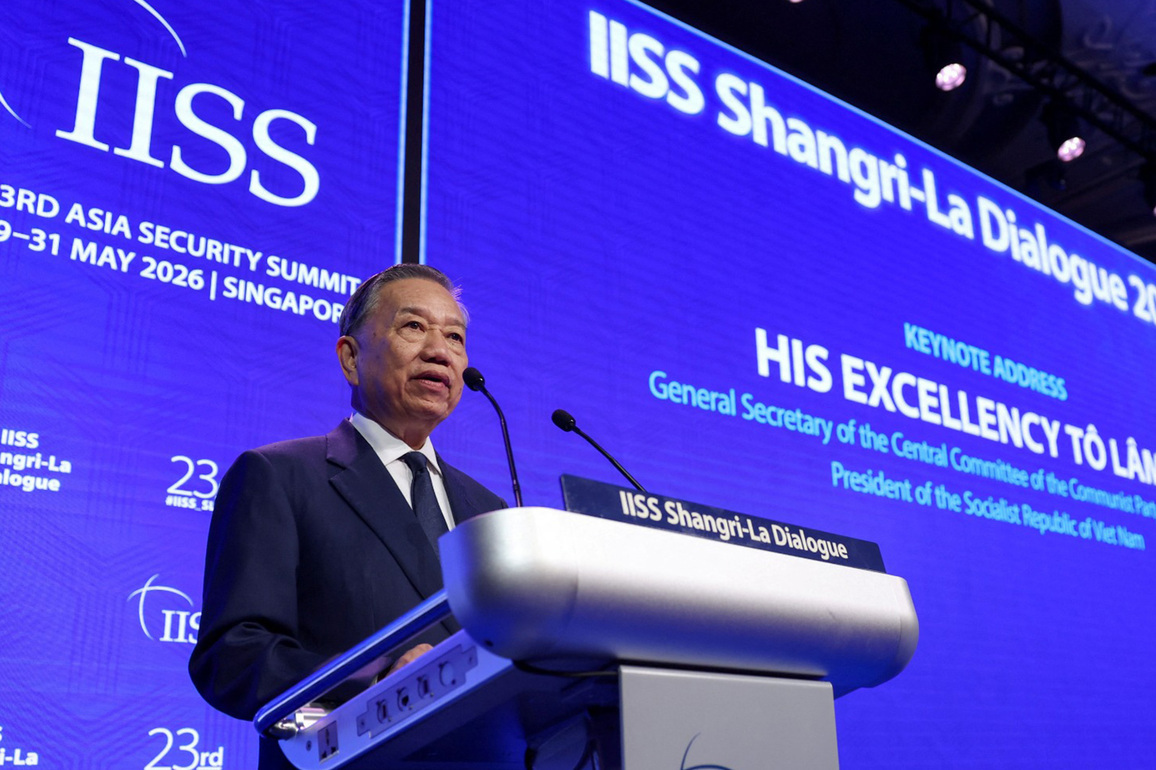
Organized by the United Kingdom-based International Institute of Strategic Studies (IISS), Shangri-La Dialogue 2026 took place from 29-31 May. To Lam, the President of Vietnam, delivered the keynote address on opening day, while US War Secretary Pete Hegseth gave a special address.
But notable was the absence of Chinese figureheads. These high-level officials have included defense ministers in the past. It is perhaps understandable that such luminaries do not wish to - or are not allowed to - currently attend Shangri-La Dialogues. After all, former defense ministers such as Wei Fenghe and Li Shangfu have ended up in detention and received suspended death sentences.
In 2026, the Chinese side was represented by Major General Meng Xiangqing - a People's Liberation Army (PLA) professor at the National Defense University - as well as Cui Tiankai, a former vice minister in China's Ministry of Foreign Affairs.
This was a bantamweight delegation indeed. It carried less heft even than last year's representation at the Shangri-La Dialogue, which was headed by Rear Admiral Hu Gangfeng, Vice-President of the National Defense University.
In some ways this step back from China is fortunate, for the IISS event gives it a platform to freely peddle its propaganda and narratives. Indeed, why should China be permitted to hawk its warlike vitriol without repercussion in an international forum?
Two years ago, for instance, Chinese Defense Minister Admiral Dong Jun declared, 'We will not allow any country or any force to create conflict and chaos in our region.' He added, 'We will take resolute actions to curb Taiwan independence and make sure such a plot never succeeds. Anyone who dares to separate Taiwan from China will only end up in self-destruction.'
China's delegates were more restrained this year, though they did reiterate favorite arguments, and point fingers at others.
Meng participated in a panel addressing threats to strategic stability. He noted 'the risk of global nuclear conflict is rising,' though he failed to acknowledge that China's friend Vladimir Putin's threat to use nuclear weapons is one such example. Meng also lamented that 'the international arms control, disarmament and non-proliferation regimes have been severely eroded. A series of nuclear arms control guardrails have collapsed. The two countries with the largest nuclear arsenals have entered a vacuum with no treaties, no verification and no dialog.'
Obviously, he was referring to the USA and Russia. Indeed, the Stockholm International Peace Research Institute (SIPRI) estimates that they possess 83% of all deployable nuclear warheads. Yet China is modernizing its nuclear arsenal faster than anybody, with SIPRI believing that China currently has 620 nuclear warheads, up from 600 in 2024. The institute said, 'Depending on how it decides to structure its forces, China could potentially have at least as many intercontinental ballistic missiles as either Russia or the US by the turn of the decade.'
It is somewhat paradoxical that Meng said 'we must strengthen consensus on arms control and uphold the nuclear non-proliferation and disarmament regimes,' while glaringly failing to admit that China steadfastly refuses to join any such treaty. Instead, Meng asserted, 'The country with the largest nuclear arsenal should fulfil their special responsibility and restart the nuclear disarmament process as soon as possible.'
China issued a white paper on arms control in November 2025, in which it singularly failed to explain why it is so dramatically snowballing its stockpile of nuclear weapons. In other words, China blames others for not submitting to arms control treaties, whilst completely spurning them itself.
Global governance is also in 'serious disorder', suffering from dysfunction, disorder and damaged credibility, he asserted. Meng shared: 'Multilateral mechanisms are heavily disrupted by bullying tactics, plunging the world into the risk of weakened rules. These risks are intertwined and make the strategic stability extremely fragile.
Faced with this situation, Chinese President Xi Jinping proposed a global security initiative and a global governance initiative, advocating a vision of common, comprehensive, cooperative and sustainable security and emphasizing multilateralism in the international rule of law, providing Chinese wisdom.'
This is the same Xi Jinping that said in 2012: 'We differ completely from Western countries in social system, ideology and other aspects. This determines that our struggle and contest with Western countries is irreconcilable and therefore inevitably long-term, complex and sometimes very acute.'
China's profound difficulty is that it wants to appear a responsible power that cares about others, but it cannot refrain from bullying and nor can it stop repressing its own people. During the recent 4 June anniversary of the Tiananmen Square Massacre, for instance, any reference to those bloody events was expunged in China. An elderly woman in Hong Kong was arrested for merely gesturing the infamous date with black-painted fingers. This is the paranoia that grips the Chinese Communist Party.
Furthermore, China has a love-hate relationship with international regulations. It is happy to abide by international rules when it confers some advantage, but Beijing immediately disparages the same rules whenever it runs counter to its own aims and narratives. A case in point is China's rejection of the Permanent Court of Arbitration's determinations about Beijing's illegal territorial claims in the South China Sea.
Meng urged the world to 'vigorously promote inclusive co-governance and build a fair and equitable global security governance system'. He said current global security governance mechanisms 'should not be defined by a handful of countries'.
'Developed countries are over-represented, while developing countries are severely under-represented. This does not conform to the trend of the times,' he opined. China therefore urged that African nations and the Global South be better represented, and that BRICS and the Shanghai Cooperation Organisation be expanded.
The National Defense University professor also fingered the AUKUS alliance and Japanese revisions to its constitution as strategic threats. Meng said, 'I believe that all countries, especially major powers, should earnestly practice the vision of a community with a shared future for humankind, and shoulder their due responsibility for strategic stability.'
He brought in a reference to Japanese imperialism too, which is forever 'nailed to the pillar of historical shame'. He asked, 'Is a country that has not thoroughly liquidated the toxic legacy of militarism qualified to talk about international defense cooperation? Can it win the trust of the international community, especially Asian countries that it invaded? I deeply doubt it.'
Koizumi Shinjiro, Japan's Minister of Defense, replied eloquently to Meng's accusations. He spoke of the same challenges that Meng did, telling the audience, '...The Indo-Pacific is facing a severe reality. Attempts to unilaterally change the status quo by force or coercion; economic coercion; challenges to the established rules; complex competition, including in cyber, space and information domains; the weaponization of everything. The boundary between peacetime and contingency is becoming increasingly unclear.'
Shinjiro point blank denied China's allegations of Japan's 'new militarism'. He said, 'Nothing is further from the truth. Think about it. There is a country that has a huge arsenal of nuclear weapons and strategic bombers. Japan has neither of such weapons. And yet Japan is labelled 'new militarism'. Is it not strange?'
The Japanese minister continued, 'Since the end of the Second World War, Japan has consistently respected international law, including the Charter of the United Nations, and has made sincere efforts to maintain and strengthen a free and open international order. Japan's path as a peace-loving nation has been valued by the region and by the international community. This fact will not be shaken by false claims, because it is a fact.'
Shinjiro further stated: 'And let me say this as well. Differences in perception and friction do arise between nations. What is needed at such time is not a repetition of unfounded claims in the other side's absence. What is needed is direct and candid dialog. And in fact, Japan's door to dialog is always open.'
Turning to China's other speaker, Cui - who was Beijing's longest-serving ambassador in the USA, from 2013-21 - participated in a separate session addressing littoral security in Asia. He acknowledged diverse challenges 'ranging from civilian to military aspects, from traditional crime, from transnational crime to non-state players, from threats to international shipping lanes to threats to what they call underwater critical infrastructure'.
He continued: 'At the same time, a few principles would apply to all of them. For instance, we have to base ourselves on respect of sovereignty and territorial integrity of the countries' concerns. We have to use peaceful consultation negotiations instead of use of force. We have to have mutual accommodation of each other's interests. And in this regard, partnership would certainly be called for.'
Yet China is heavily engaged in bullying Philippine fishermen and government assets in the South China Sea, especially within the Philippines' own exclusive economic zone. Images recently emerged showing that China has built a small structure on Scarborough Shoal, a natural feature 220km west of Luzon that Beijing seized from under Philippine noses in 2012. China has shown absolutely no desire to mutually accommodate Philippine interests, which makes a mockery of Cui's words.
Cui also defined the 'partnerships' that he called for above, these being different to alliances or military blocs. 'As far as I can see, the former is open, inclusive, cooperative and is based on equal footing, as the latter is more or less closed, exclusive, sometimes confrontational and could be threatening to the interests of others. The former is constructive and would help us to have an effective and collective response to the challenges, while the latter is very often disruptive and probably would produce more problems than solutions.'
He highlighted that China is as concerned as the rest of the world about closure of the Strait of Hormuz. China is the largest trading partner for perhaps 100 nations around the world, and he said his nation is 'doing whatever we can to try to bring the situation back to normal'.
But taking a justifiable dig at the USA, he posited: 'We have to ask ourselves some maybe more relevant questions. How the tension started? Why is it so high? What is the right way out? What can we do together to bring it to a peaceful solution through negotiations and consultation? The right choice is to have a good security approach that would emphasize common, comprehensive, cooperative and sustainable security for all and international rules that will apply to all.'
Cui also alluded to the buzz phrase of the USA and its allies - a 'free and open' Indo-Pacific. 'These are good words, but the point is that they should be free and open for all, not just for a few. Asia-Pacific will not be free and open if a few countries try to gang up to intimidate others or try to deprive others of their legitimate right to develop. And the region will not be free and open if there is an ongoing attempt to divide the region into confrontational blocs. And the region will not be free and open if the outcome of the anti-fascist war is challenged or even denied, and militarist national policies are reintroduced under new excuses. And the region will not be free and open if cooperative regional approaches and practices and mechanisms that have served us so well are abandoned and replaced by destructive and confrontational ones.'
Ironically, Cui said, 'In a word, if anyone tries to have total and absolute freedom at the expense of others' freedom, then there is no freedom for anyone.' He added, obviously referring to Trump: 'If anyone tries to force into other countries' market, territory, domestic affairs, while raising protectionist barriers against others, then there is no openness for anyone.'
Ironically, China is one of the most closed countries in the world, a society where 'there is no openness for anyone'. (ANI)